Wednesday, August 18, 2010

glastonbury


I’m not really sure how we chose Glastonbury as a site worth visiting. Perhaps the British Heritage site had a great photo. Perhaps we were intrigued by its history—legend holds that it is Avalon. In the end, we went because it was close to where we were staying, and because I needed to see ruins. I have a thing for ruins, which I can’t yet put into words, but my love goes back twenty years to Whitby Abbey. 
                                                    
Glastonbury has abbey ruins in spades. King Arthur and Guinevere are believed to be buried here. Joseph of Arameathea walked here, allegedly. This place is rich in leylines. Though please don’t ask me to explain.


The town is fascinating. Every store holds woo-woo: crystals and buddhas and fairies and Native American talismans. Plus, you can get spiritual alignments. 

And, then just outside of town is the tor. Someone at the abbey visitor’s center gave us a hand-drawn map with a dotted line leading directly to the tor. We cut through two fields and climbed forever before we got to the steps that took us up the backside of the hill. At the top, we zipped our jackets and gazed at Wales.
Glastonbury is also the site of a significant music festival, which was to take place just a week after our trip. Four days, forty-five stages. Need I say more? On one hand, I was glad to not deal with the masses. The festival attracts over 150,000 people. Yes.  On the other hand, the 2010 line up was pretty spectacular, perhaps a bit overwhelming, even. Well, see for yourself. Seriously, who didn’t play here? See that Gorillz, Snoop Dogg, and Corinne Bailey Rae appeared on the same stage. Crazy!

Friday, August 13, 2010

standing stones


As we planned our England trip, our highest priority for sightseeing was anything Bronze Age or earlier. The UK is peppered with standing stones, stone circles, menhirs, dolmens, and quoits. The Stone Pages was an invaluable source, and it’s fun to browse even if you’re not trip planning. Once we actually started traveling, our theme changed a bit, but we still managed to see a megalithic England with an emphasis on Avebury and Stonehenge.

Before our trip, we received much unsolicited advice to visit Avebury, especially making it a priority over Stonehenge. I had seen Stonehenge and other stone circles on a previous trip to England so I was aware that there were equally impressive, but different, types of stone circles. 
Avebury covers a larger area than Stonehenge. In fact, it encompasses an entire village (above; though it's difficult to see the stones, this photo was show part of one half of the outer circle). Many of the formations are similar to Stonehenge, including the avenue of stones leading to the entrance as well as stones that are believed to have played a part in sacrifices. Avebury consists of a large outer stone circle, which once held 98 megaliths, and two smaller circles, each with approximately 30 stones. In some ways, Avebury and Stonehenge are sister sites in that their stones share the same source—the Marlborough Downs. 
This ancient tree is allegedly where J.K. Rowling wrote Harry Potter. Gnarly.

More on Avebury: This site has incredible photographs (check out the wallpaper section!) and massive amounts of information. Please visit, if you’d like to learn more.
Stonehenge is all that. Don't let anyone tell you otherwise. The stones are massive. Look at the lintels. One cannot help but wonder how the monoliths got to this site, how they were propped up, and why. How many people did it take to hoist those lintels?? What exactly was the purpose of this place? 

Notice how you don't see many tourists in the photos? It wasn’t difficult to filter out the masses once we were on the path. The bottleneck at the entrance, however, was so bad we almost left. I’m glad we didn’t. Twenty years ago, I never paid admission or crossed the road to get as close as possible to the monument, and I’ve regretted it since. 
John and I must have taken a photo every inch we advanced in our circumnavigation, trying to capture Stonehenge from every angle. And, yes, that Spinal Tap song played on an internal loop for days after.

Wednesday, August 11, 2010

white horses

On our first full day in England, we ate a Hot Breakfast and hit the road for Avebury. But first, at the recommendation of the innkeeper, we followed the brown attraction signs to Uffington in order to see a white horse. The Uffington white horse was the first of its kind—a large horse carved into a hill and filled with chalk so it could be seen from a distance. 
The carving dates to the Bronze Age. The horse’s purpose is still debated, though it is thought to have belonged to the Uffington Castle, a village with a fortress and earthen moat (pictured above) that ring the hilltop. Until the nineteenth-century, the horse was cleaned annually in a ritual called the Scouring, where the villagers would pull the weeds and grass from the horse and refresh the chalk.
The National Trust maintains this site so we were able to drive to the top of the hill, park the car, and take an effortless hike through a sheep meadow to get to the horse. We spent a lot of time here, primarily because the views were so stunning. 
On a clear day, we could see forever. The boys took full advantage of strong winds and flew a kite on Dragon Hill, situated just below the white horse. An impression of this place will stay with me for a very long time.
The Uffington white horse is one of eight that remain (at one time there were 13). Another white horse is just outside of Calne, where we would be staying for the next two nights. Among all the things to do in the area—Bath and various other sites were nearby—climbing another hill to see a hill carving was not high on my list. But the following day, still fighting jet lag and exhausted after a wonderful morning in Bath, we took naps then had a pre-dinner hike up Cherhill.
The Cherhill white horse is the third oldest, but its origins are sketchy. This is county Wiltshire’s official story (courtesy of wikipedia): 
The figure at Cherhill was first cut in 1780 by a Dr Christopher Alsop, of Calne, and was created by stripping away the turf to expose the chalk hillside beneath. Its original size was 165 feet (50 m) by 220 feet (67 m). Dr Alsop, who was Guild Steward of the Borough of Calne, has been called "the mad doctor", and is reported to have directed the making of the horse from a distance, shouting through a megaphone from below Labour-in-Vain Hill. His design may have been influenced by the work of his friend George Stubbs, notable for his paintings of horses.
Dr. Alsop buried glass bottles in the ground to form the horse’s eye. For years the bottles were replace when they disappeared, but at some point, people stopped that tradition. Our hike was fantastic. We followed the footpath up the steep hill to a monument. The clever turnstile we climbed is pictured above. The boys ran the whole way. Some kind hikers told us the boys had been spotted near the castle. As at Uffington, there is no actual castle. No ruins. Just a moat that surrounded the village. The castle was vast; I said a silent prayer that the boys weren’t taking a lap. But then we saw them near the white horse. 
On our way down, we walked through the middle of a cattle herd, which was frightening. John had a stare down with a cow that thought s/he’d follow us. He raised his hand, and the cow backed off. Simon took this picture; it's more ground than cattle but you get a sense of what we were up against.
These hikes would form the basis for our trips theme: climb to the top of big hills.

Monday, August 09, 2010

happy campers


The boys are at sleepaway camp this week. The house is very quiet. John and I have bogarted the dinner menu and the TV. The cats are relaxed and haven't once gone into hiding.

That said, I miss them so much. It would be nice if I could call them each night, before they go to bed, so I could hear about all the exciting things they did that day.

Monday, July 26, 2010

catching up

My friend Krista once used the expression “running to stand still.” At the time, I had never before heard it, but it made immediate sense. Since then I have come to realize that I am running and running and running, and I may never stand still. That’s okay. I am able to catch my breath from time to time, which suits me fine. But currently I feel as if I will never catch up. Stuff is piling up around me, including a freelance assignment I took because I thought I’d lose my mind if I didn’t have some project brewing. I can’t point fingers because we’re all equally responsible, but I’m looking at piles of so many abandoned and neglected things. It’s sad really, and maddening to think this might be the environment in which I dwell.
 

Wednesday, July 07, 2010

full english breakfast

It seemed really uncivilized to bring my camera to the table first thing in the morning, but now I regret that I don’t have a picture of a full English breakfast. Thank goodness for the internets where I borrowed a photo from www.spinneybedandbreakfast.co.uk.


Where to start with the full English breakfast? I have really fond memories, from 20 years ago, of getting a hot breakfast whenever I stayed in a bed and breakfast. As I made hotel reservations for this trip, I got a little excited by the promise of a cereal “starter” (cornflakes or “bits and pieces,” muesli with dates and nuts), followed by runny eggs, thick bacon rashers (recognizable to Americans as ham), fat English sausages, baked beans, and broiled tomatoes and mushrooms. Toast and preserves? Yes, please.


Even if taking Lipitor, people my age should not eat a full English breakfast every morning, for obvious reasons. But eggs and bacon are so delicious, and I only had five mornings to take advantage of consuming them. The boys loved their full English, especially since they were allowed to drink milk and sugar–laden “wake up” tea, which is what our family calls English breakfast tea. To their credit, a full breakfast tided us over well past the lunch hour, but sometimes they also made us feel like we needed a nap at 10 a.m.

Monday, July 05, 2010

Dartmoor and the tors


Dartmoor National Park has just become my most favorite place on earth. When I think about national parks, the most immediate image is of a forest, such as those I have visited in the U.S.—Rocky Mountains, Acadia, and Yellowstone. Dartmoor, however, was deforested in the 17th century. The trees served as raw material for England’s ship-builidng industry but were never replenished.  As a result, Dartmoor’s topography is bare and rugged. Its chief geological feature is a series of over 160 tors, large hills with granite outcroppings.

If we'd had an ordnance survey map, finding a specific tor might be easier, but we were navigating by a google map that showed only a few B roads and lacked any meaningful detail. We were trying to find Hound Tor, which, according to glossy travel guide photos, seemed to be pretty significant—a giant outcropping. At some point after spying an imminent left turn, John said, “We’re going to take this road and see where it goes.” A quarter-mile later we spotted a rocky outcropping that seemed worthy of exploration. Lo and behold, the road held a turn-out where we could park the car.


A quick hike up the steep hill, then a pleasant walk across the hill top, followed by a climb on the rock formation and we were rewarded with incomparable views. The sky was clear and an amazing shade of bright blue, providing a crisp contrast to abundant rocks. Stone walls divide fields, creating a verdant patchwork quilt.


Below the tor, nestled at the base of the next hill (Hameldown) was a large stone circle with smaller stone circles inside. I had read about these circles in a travel guide and knew that it was a Bronze age settlement; the smaller stone circles, called “hut circles,” were houses. Some had very obvious entrances, or front doors, while others showed evidence of fireplaces or hearths. Talk about hitting the motherlode.
At some point, John and Simon headed up Hameldown to see what was on the other side, while Winston and I poked around the hut circles, trying to imagine which house would have been ours had we lived in the Bronze Age. Soon two women, who were out walking their dogs, joined us. We shared some chit-chat. Mostly I wanted to know where we were since the site wasn’t signposted. They didn’t know, which struck me as interesting since they were both locals out for a walk, though one of the women identified the circle as the Grimspound. She told me it was the exact spot where A. C. Doyle had set key scenes in The Hound of the Baskervilles and that I should be reading it at that very moment.
Regardless of missed opportunity, Hookney Tor, which we identified on the huge OS map at Lydford House, and the Grimspound were incredible. I feel luck or good fate had been on our side when we stumbled upon the tor. Later that evening, over a bottle of pinot grigio, John and I plotted our return to Dartmoor. I could be very happy renting a house for a month and walking every tor, plus finding the standing stones and clapper bridges we missed this time around. Until then, I have captured Dartmoor’s beauty on a remarkably sunny day, and I have sources, such as Doyle’s long story and websites to sustain my memory.

Saturday, July 03, 2010

signs


Thursday, July 01, 2010

driving in England


Driving in England merits attention. In a word, the experience is nerve wracking, whether you’re behind the wheel or in the passenger’s seat. If you’re behind the wheel, the brain plugs into the responsibility and safety centers so you don’t have to focus on the fact that you’re on the opposite side of the road.
We wisely rented a car at Heathrow and immediately hopped on the M4, the motorway that delivered us to Oxford. Being on a road equivalent to our interstates or freeways meant that we could go with the flow of traffic to get a feel for all the new variables without needing to negotiate roundabouts or roads that are only two Yugos wide.
So we’re clipping along blithely, and at some point, we realized we had no idea what the traffic signs meant, nor did we know the general rules of the British road. What is a circle with a 50 in it? Is that the speed limit? Is the speed limit in mph or kph? Are we really meant to drive 50 mph on what would be a 25 mph road at home?
Soon we dove right onto those small A and B roads. We gritted our teeth and quickly found strategies for dealing with oncoming traffic (lorries [trucks] barreling at us, often well over the generous speed limit) and bicycle tourists; roundabouts (which spur do we take, to whom do we yield when entering); road signs that occasionally drop a destination, leading us to wonder if we missed an exit; and hedgerows. When I drove, John would tell me when the car veered too close to the left line because the road often had no forgiving shoulder. When John drove, I would remind him to swing out wide for right turns because if you make a right turn as you do at home, i.e., as is hardwired, you’ll end up on the wrong side of the road. And, often, there’s no way to pull a U-turn.
In the end, we turned in our rental car without incident and without any (obvious) extra scratches. I’m glad I had the experience of driving under incredibly unique circumstances.

Wednesday, June 30, 2010

Oxford

Twenty years ago, I could navigate Oxford by the back of my hand—from the train station through the campuses and botanical gardens and college backs along the Thames. Smaller than London and oozing with higher learning, Oxford was a magical place for me.
We started our trip in Oxford. This small city is only a 45-minute drive from London Heathrow, which meant that we wouldn’t need to do much jetlagged driving to get to our destination. Also, Oxford is a small city that is manageable by foot so we could park the car at the guesthouse and walk everywhere. And, walk we did. After we checked into the Newton House Guesthouse, located on the Abingdon Road (literally the road to Abingdon), we made the short walk to Christ Church, one of the largest colleges (and most beautiful, in my humble opinion) in the University. From there, we walked to the Eagle and Child, my favorite Oxford pub. I spent a fair amount of time here during my Junior Year Abroad, particularly on the patio, which is now covered. The Eagle and Child was also the favorite pub of J.R.R. Tolkien and C.S. Lewis. In some ways, the cramped but cozy front rooms, with their tacky “patina” of age, make me think of a hobbit hole.
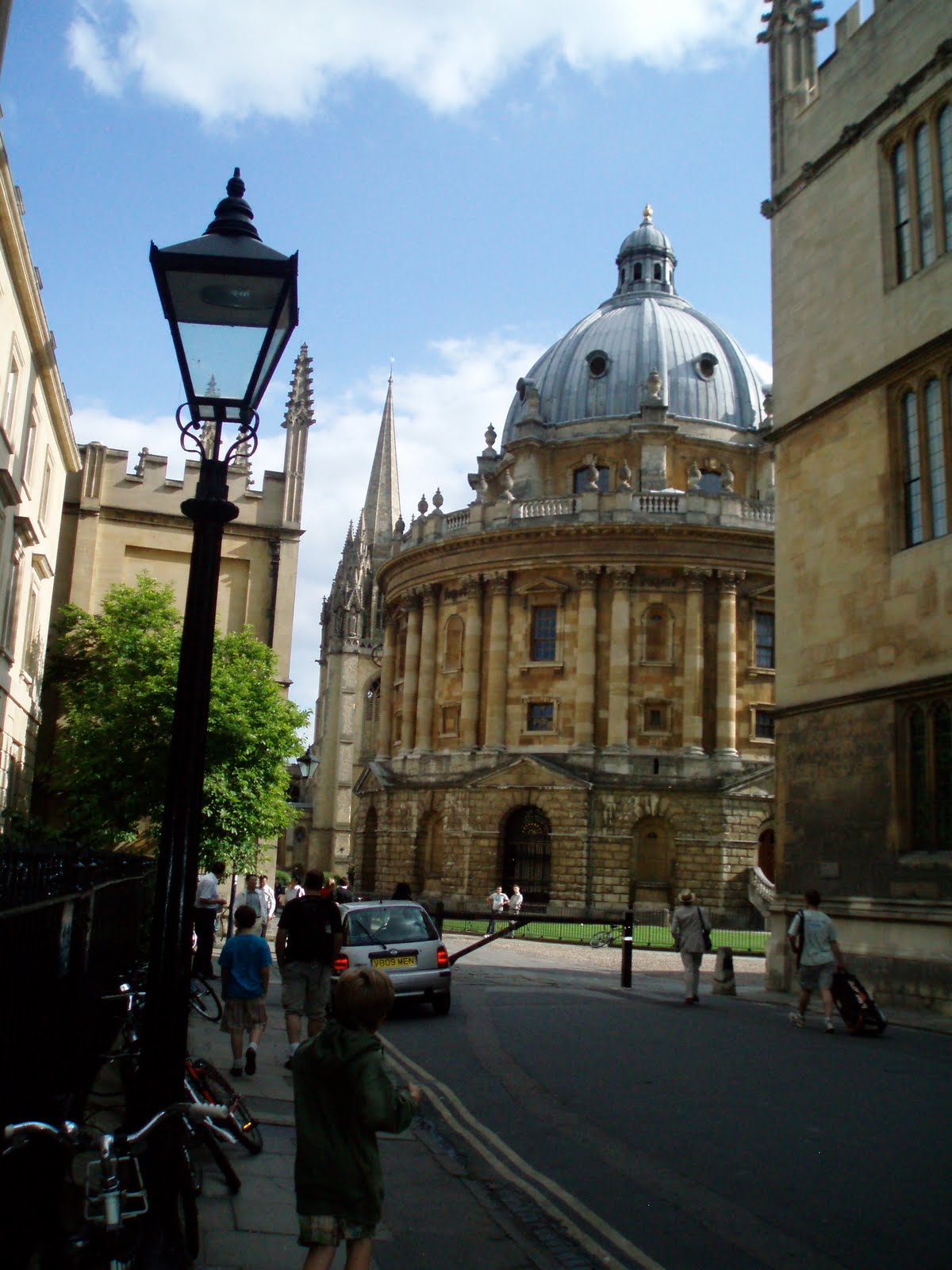
After a pub dinner (fish and chips and steak pies with mashed potatoes) and a pint, we walked back to the guesthouse, cutting through the university “campus” along the way. John and I decided to hit the highlights—the Bridge of Sighs, the Sheldonian, the Radcliffe Camera (Bodleian, above right)—then head down the road in the morning rather than do any further touring.
Oxford was busy with an unappealing combination of extra people in town for graduation (one gown was festooned with downy white mariboo feather, pictured above left, with Bridge of Sighs, a fancy skyway), as well as a far number of tourists. Plus, I noticed now what I didn’t notice as a twenty-year-old: Oxford felt a little shabby. Sure the High Street has tony gentlemen’s stores, where you can buy college scarves and ties, as well as an occasional hip women’s clothing store and a smattering of antique map shops. I loved the window display with stylish papier mache globes made from carefully torn maps. Ultimately the throngs and the wrappers in the street obscured my golden memories.
The highest point of the visit was the walk through the Christ Church Meadow (above left and right), which is still one of the loveliest spots I know. Quiet and populated mostly by civilized small groups, picnicking and enjoying a glorious early summer evening. 

Monday, June 28, 2010

England '10


For the past week, I have been trying to process the sounds, smells, and sights of our amazing trip to England. I have dumped three cameras’ worth of photos into iphoto. Now I’m migrating photos to facebook and flickr, to share and for posterity, but uploading and labeling is a really slow exercise. What I really want to do is write a book-length essay about every detail so I never forget this trip that we’re not likely to repeat soon. But for now, I replay the scenes that form the metaphysical space between each photograph.
Highlights:
climbing to the top of steep hills, which became our theme pretty quickly // 
not only spotting a white horse or two from the road, but seeing them close up // joining the National Trust, for which we dictated our vitals to a clerk who wrote the info up on an NCR form; the process took forever // marveling at the woo-woo New Age-y town of Glastonbury // lunching on pasties purchased in West Country bakeries // enjoying beautiful weather (mid-70s, blue skies, sunshine), which allowed us ridiculous vistas // 
making a pilgrimage to Persephone Books on Lamb’s Conduit (London) and finding a few souvenirs  // drinking countless pints of cider // meeting the local color by way of passionate innkeepers, waiters, and regulars // watching the boys fly kites on Dragon Hill // watching a hawk hunt while floating on a current at Stonehenge // walking the one-mile, standing stone–dotted perimeter of Avebury // 
overshooting the road to Hounds Tor in Dartmoor because our randomly chosen backup tor was Hookney Tor and the Grimspound, which is the setting for Sir Arthur Conan Doyle’s Hounds of the Baskerville // spending two glorious nights at Lydford House, between Okehampton and Tavistock // dipping my toes in an absurdly cold English Channel 
more to come

Monday, June 21, 2010

home

Cliched though it may be, there's truth in the expression There's no place like home.


We're back after 10 days in the U.K. Each of us is out of sorts. I'm looking forward to having more fortitude to write about our amazing trip. My little family spent serious high-quality time together. We saw some pretty spectacular things and met characters we're not soon to forget.


The photos are uploaded. We're working on the stories that will become part of the family history. I will be back soon.


As a preview, you should know that we walked through this cattle herd, and the experience was a tad fraught with fear.

Monday, June 07, 2010

creative


On I whim, I stopped by The Bead Monkey on Friday. Perhaps it wasn’t really a whim since I had an idea for a simple, go-with-everything earring. Instead of a surgical strike where I stayed focused on my plan, I browsed, which is how I came to also own the beads to make these beauts. 

Tuesday, June 01, 2010

hello june

I never thought you’d get here. Summer, the season, officially begins in June, though, in terms of the weather and my mental state, it's here now. June is also when my little family has decided to take summer vacation. It’s early, I know, but we want to get a jump on crowds and feel like we have some little corner of the world to ourselves.
We wrapped up May with a quick trip to Watertown. In an unusual move for us, we left town on Saturday morning rather than straight from work on Friday night. I was hoping for a less stressful start to what is often a stressful weekend with my parents. John and I got a little extra sleep on Saturday morning, and we took the boys to Bread and Chocolate for pastries before pulling out of town. Perhaps many Twin Citians left for The Lake on Friday because Saturday traffic was minimal. Nice. The skies were bright blue, which is always a perfect foil to the endless brown prairie.
Watertown was hot and windy when we arrived. If you’re an 8 or 10-year-old boy, then this is the perfect weather for a dip in chilly Lake Kampeska. On Sunday, the temps dipped to cool high 70s, which was a pleasant reprieve unless you wanted to go swimming and sliding at the water park. Without going into a play-by-play, we had a lot of quality family time. My sister Michele, who recently spent six months in Nepal and India, pulled out all the stops with a Nepalese dinner. We had a urad dal but also a stewed kale and carrot dish that was really nice. But the best thing we ate was the result of an error. Michele tinkered with a recipe for tomato and cilantro chutney that apparently didn’t turn out the way that is was intended but that was so delicious that I can’t stop thinking about it.
In a nutshell, we saw lots of people, played miniature golf at Thunder Road (this was a first), had a bonfire, and slept in our spacious six-person tent. The latter was an adventure. The wind was strong off the lake the first night, which I found wholly disconcerting. Mostly the wind rustled the trees overhead, but occasionally it would pick up and cave in the sides of the tent. Around 4:30 a.m., a nice, drenching rain started. Needless to say, I didn’t sleep very well. The second night was still, and—best—we had pillows for our heads.
Apropos of Memorial Day, I spent some time thinking about some of my favorite people who have passed—my grandparents, my Uncle Leo (my grandfather's closest friend, who was a second grandfather to us and could do the most amazing and realistic animal impressions), Geo J (a fellow bookseller from OBSP days, always put a book in people's hands, hip to John Grisham before he became a NYT bestseller), and Frances (our dear neighbor and kidsitter who died way too young, a month short of graduating high school and setting the world on fire).
And, I thought about my friends S and L, who were married on Memorial Day weekend fourteen years ago. I don't know the exact date of their wedding but it will forever be linked to this holiday. Last night I wished S a happy anniversary and he snorted but said thanks. I know that his marriage has been troubled for some time, but they always seem to put on a good face when they're together in public. I'm trying to avoid making this gossipy but last night I learned that they've hit an especially rough spot. I can't help but think about the promise I made at their wedding to stand by them but he's pretty unhappy and it's hard to know how best to help.
Heavy stuff aside, it was a very good weekend.